By The EasyWebSight Desk
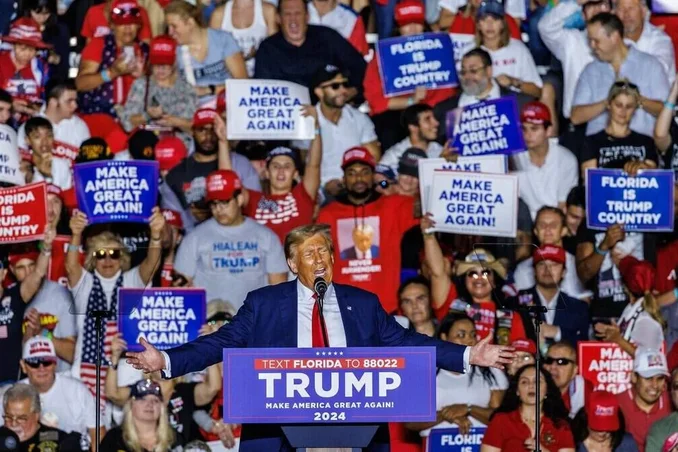
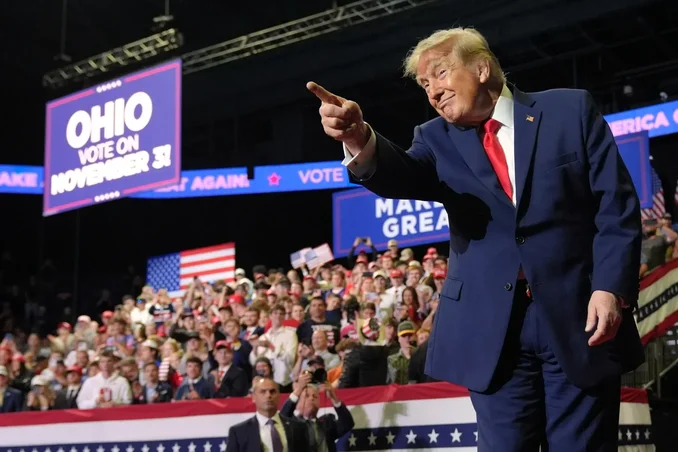
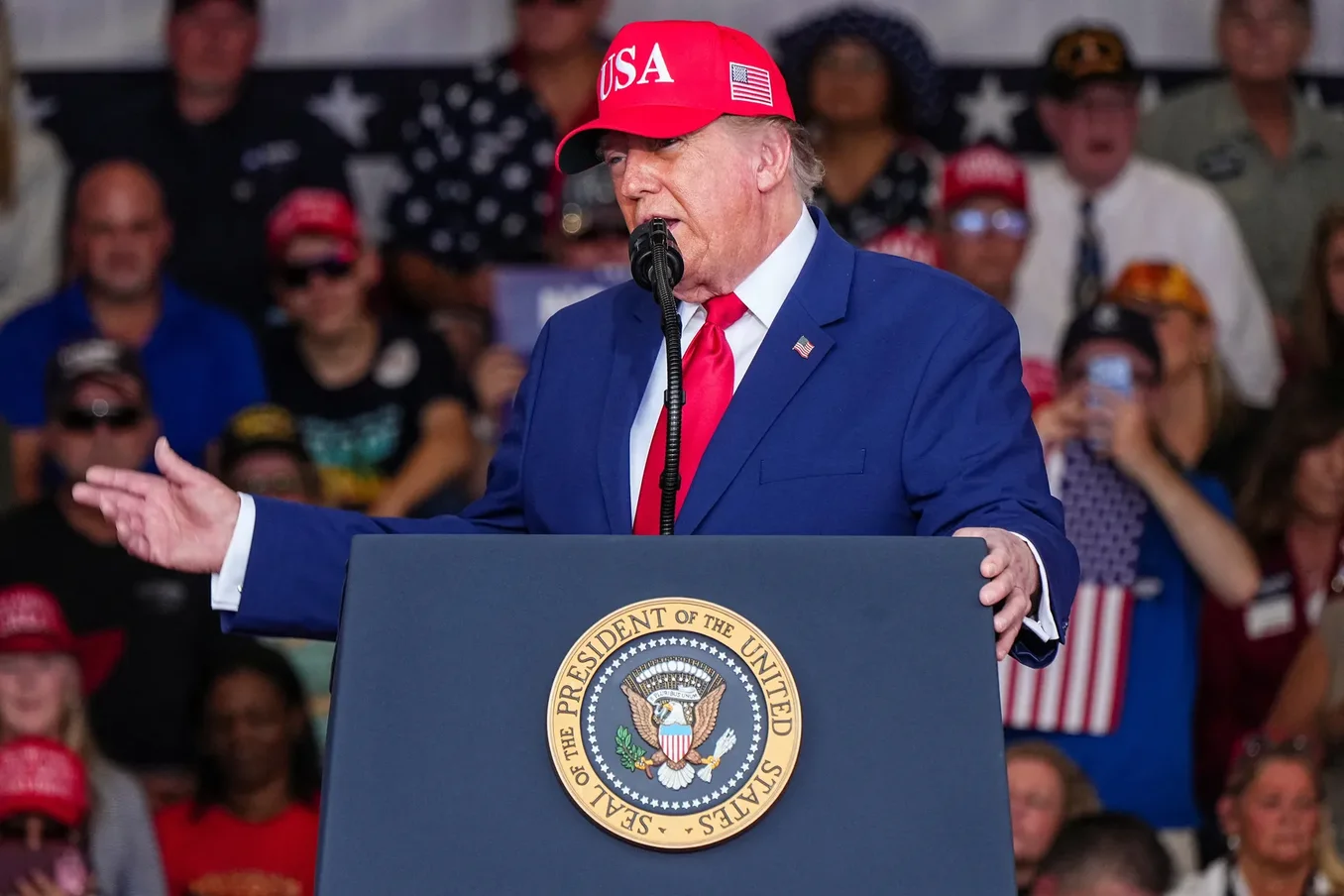
DALTON, Georgia, October 16, 2026 — President Donald Trump once again demonstrated his willingness to turn cultural and religious identity into political entertainment. Speaking at a campaign rally in Georgia, Trump mocked the prevalence of the name Mohammad among Muslims while ridiculing Iran's political leadership.
According to Reuters, Trump told the crowd:
"You know, if you're in doubt about somebody's name from the Middle East, just say 'Mohammad.'"
He went on to claim there was a 65 percent chance of being correct, boasting that he had used the supposed trick for years without being wrong.
Trump then pretended to address several imaginary individuals named Mohammad, asking whether they wanted to become president of Iran.
The audience's reaction, Reuters reported, was muted.
Perhaps even some of Trump's supporters recognized that the joke was neither particularly clever nor especially appropriate. Or perhaps the moment simply failed to produce the laughter he expected. Whatever the explanation, the incident revealed something more troubling than a failed attempt at humor: a president's casual willingness to reduce an entire religious and cultural tradition to a stereotype.
A Name Rooted in Reverence, Not Ridicule
Mohammad, also commonly spelled Muhammad, Mohammed, or Mohamed, is among the most widely used male names in the Muslim world. Its popularity is not an accident, nor is it evidence of some cultural deficiency deserving ridicule.
For countless Muslim families, the name represents respect for the Prophet Muhammad, the central prophetic figure of Islam. It connects generations through a shared religious and cultural heritage.
A child named Mohammad may grow up to become a physician, engineer, teacher, scientist, journalist, public servant, or political leader. His name tells us nothing about his intelligence, character, ambitions, or beliefs beyond whatever meaning his family attaches to it.
Yet Trump chose to present that name as a convenient shorthand for an entire region.
There is an obvious difference between criticizing the Iranian government and mocking a name shared by millions of Muslims who have no connection whatsoever to Iran's leadership.
The first is legitimate political discourse. The second is cultural stereotyping masquerading as humor.
And when the person delivering that stereotype is the president of the United States, the implications extend well beyond a campaign rally.
But What Does the Name Trump Bring to Mind?
Here is where the irony becomes impossible to ignore.
If Trump believes a name can be used to generate laughter through its associations, perhaps Americans should consider the associations attached to his own.
What comes to mind when someone hears the name Trump?
For his supporters, the answer may be business success, political defiance, nationalism, or a willingness to challenge established institutions.
But for millions of others, the name evokes a considerably darker collection of associations: criminal conviction, legal battles, allegations of misconduct, political insults, inflammatory rhetoric, and a seemingly endless procession of controversies.
Unlike the name Mohammad, which is widely given as an expression of religious reverence, the political reputation attached to Donald Trump's name has been shaped substantially by his own conduct.
That distinction is fundamental.
People should not be judged by the names they inherit. Public officials, however, can and should be judged by the reputations they create.
Trump's name did not become controversial because millions of unrelated people happened to share it. It became controversial because of the actions, statements, business practices, and political decisions of one extraordinarily prominent individual.
A Name Associated With Courtrooms and Controversy
Consider the legal history surrounding Donald Trump.
In May 2024, a New York jury convicted him on 34 felony counts of falsifying business records in connection with payments intended to conceal a politically damaging story before the 2016 presidential election.
Trump has disputed the prosecution and pursued legal challenges to the conviction. Nevertheless, the jury's verdict remains a documented part of his public record.
That alone creates an extraordinary contrast.
The president who casually jokes about the name Mohammad is himself a man whose surname became attached to the unprecedented criminal conviction of a former American president.
His public history also includes civil litigation, business disputes, allegations of sexual misconduct, and years of political controversy. Some matters resulted in judicial findings or verdicts; others remain allegations, disputed claims, or matters of public debate. They should not be treated as interchangeable.
But collectively, they have helped shape the public meaning of the Trump name.
And that meaning has been constructed not by an ancient religious tradition, but by decades of decisions and conduct.
There is something deeply revealing about a politician who is quick to make another community's name an object of amusement while fiercely defending his own reputation against criticism.
Even the Kennedy Center Rejected the Trump Name
Perhaps one of the most striking illustrations of the controversy surrounding Trump's name emerged in Washington in 2026.
After Trump's name was added to the John F. Kennedy Center for the Performing Arts, a federal judge ruled that the institution's board had acted unlawfully in approving the change.
In June, the administration complied with the court's order to remove Trump's name from the building's signage, website, and official materials.
The episode was extraordinary in its symbolism.
Here was a president whose name had been placed on one of America's most prominent cultural institutions, only to be removed following judicial intervention.
The significance was not that the surname Trump was inherently objectionable. It was that the attempt to attach his name to an institution honoring another president had exceeded the board's legal authority.
Yet the public spectacle offered an unmistakable reminder that a powerful person's desire to see his name celebrated does not automatically confer legitimacy or respect.
A name can be displayed in enormous letters on a building. That does not mean it has earned the admiration of the people who walk past it.
And respect, unlike signage, cannot simply be installed.
The Epstein Shadow and the Importance of Facts
The Trump name has also appeared in reporting and documents concerning Jeffrey Epstein, the disgraced financier and convicted sex offender whose connections with wealthy and influential individuals have generated years of public scrutiny.
Trump and Epstein were previously acquainted socially, and references to Trump in Epstein-related records have attracted significant attention.
But a crucial distinction must be maintained: appearing in investigative records, social correspondence, or released documents does not itself establish involvement in Epstein's crimes. Allegations must be evaluated on their evidence, not on association alone.
That distinction matters precisely because the purpose of this editorial is not to replace one unfair stereotype with another.
The legitimate criticism concerns Trump's documented conduct, his public statements, and the questions raised by his relationships and decisions—not the assumption that every accusation or insinuation is necessarily true.
Nevertheless, the Epstein controversy illustrates how the Trump name has become entangled in public debates far removed from the image of prestige and success that Trump spent decades cultivating.
A president who insists that his own name deserves recognition and respect should understand why other people feel protective of theirs.
The Politics of Humiliation
Trump's remarks about Mohammad were hardly an isolated example of his political style.
For years, he has used insulting nicknames, personal mockery, and provocative generalizations as instruments of political communication.
His attacks on opponents frequently substitute ridicule for substantive disagreement. His rhetoric about immigrants and minority communities has repeatedly drawn criticism from civil rights organizations.
During the 2026 midterm campaign, his remarks about Muslim and Somali Americans, including Representative Ilhan Omar and Senate candidate Abdul El-Sayed, drew renewed attention to that pattern.
The strategy is familiar: identify a target, reduce that target to a memorable caricature, and invite the audience to participate in the humiliation.
It is political entertainment built around the degradation of someone else.
Defenders call it humor. Supporters may regard it as evidence that Trump refuses to submit to conventional political etiquette.
But there is a meaningful difference between challenging political correctness and displaying contempt for cultural or religious identities.
A president can be forceful without being insulting. He can criticize Iran without ridiculing Muslims. He can oppose an adversary's policies without treating a name shared by millions as a punchline.
The problem is not that Trump tells jokes.
The problem is what he repeatedly chooses to joke about—and whom those jokes invite his audience to diminish.
When the Joke Is Turned Around
Imagine, for a moment, a political leader addressing an audience and suggesting that the name Trump has become a convenient synonym for scandal, dishonesty, or political chaos.
Imagine that leader pretending to address a room filled with people named Trump, asking which one had been convicted of a crime or which one was involved in the latest controversy.
Trump and his supporters would have every right to object that such a performance unfairly stigmatized innocent people who happened to share a surname.
And they would have a point.
Because the moral principle should be the same regardless of whose name is being mocked.
A surname does not make someone dishonest. A religious name does not make someone foreign, threatening, or ridiculous.
But there is a difference between mocking everyone named Trump and holding Donald Trump personally accountable for his own actions.
That is the distinction his Georgia joke failed to respect.
Mohammad is a name borne by millions who deserve to be judged as individuals. Donald Trump's public reputation belongs to Donald Trump, and he must answer for the choices that shaped it.
The irony is not that one name is superior to another.
It is that the president appears eager to exploit the cultural associations of other people's names while expecting his own to command extraordinary deference.
A President Should Know Better
The United States is home to millions of Muslims who contribute to American life in countless ways.
They serve in the military, practice medicine, teach in universities, operate businesses, raise families, hold public office, and participate in the same civic institutions as their fellow citizens.
Many carry the name Mohammad or one of its variations.
They are not props in a president's political performance.
Nor should they be expected to accept ridicule of a name associated with their faith simply because the ridicule was delivered with a smile.
America's constitutional commitment to religious liberty means more than allowing people to worship privately. It reflects a broader civic principle: that citizenship and human dignity do not depend on belonging to the majority religion or cultural tradition.
The president has a special responsibility to uphold that principle.
His words can influence how communities perceive one another, how political supporters treat their neighbors, and how the nation presents itself to the world.
When he mocks a name associated with Islam, he risks reinforcing the idea that Muslim identity is something foreign or inherently laughable.
That message is especially damaging when it comes from the nation's highest office.
The Difference Between a Respected Name and an Earned Reputation
There is one final irony worth considering.
Trump has spent much of his professional life promoting his surname as a brand.
It has appeared on buildings, hotels, products, campaign merchandise, and political institutions. His business identity was built around the proposition that the Trump name itself represented value.
He understands, perhaps better than most politicians, the symbolic power of a name.
He understands that names can carry prestige, recognition, emotional significance, and financial worth.
Yet he apparently sees no contradiction in treating another community's cherished name as material for casual ridicule.
That contradiction exposes the central failure of his remarks.
Trump wants his name associated with greatness. He wants it remembered, displayed, celebrated, and respected.
But he appears less concerned about respecting the names that matter deeply to others.
And there is a larger lesson here.
The name Mohammad has endured for centuries because of its religious and historical significance to Muslims around the world.
The political meaning of the name Trump, by contrast, will be determined by the historical record of Donald Trump's presidency, his conduct, and the consequences of his decisions.
No campaign rally can settle that judgment. No branding campaign can dictate it. No presidential decree can guarantee a favorable verdict from history.
The Last Laugh May Belong to History
Donald Trump may have intended his remarks in Dalton, Georgia, as a harmless joke about the popularity of a Muslim name.
But the episode raises a far more serious question about the character of presidential leadership.
What does it say about a president who mocks a name revered by millions while insisting that his own name deserves admiration?
What does it say about a political culture that rewards the humiliation of minorities more readily than it demands accountability from the powerful?
And what does it say about American leadership when a president appears more interested in provoking laughter than demonstrating respect?
There is nothing inherently shameful about the name Trump, just as there is nothing inherently amusing about the name Mohammad.
The difference lies in the conduct of the people being discussed.
Millions of people named Mohammad have done nothing to deserve a president's ridicule.
Donald Trump, on the other hand, has spent decades making choices that invite legitimate public scrutiny, criticism, and historical judgment.
He may laugh at the name Mohammad, but the name Trump now carries a burden that no joke can erase: the weight of his own record.
And when history finally assesses that record, the question will not be how many people laughed at his rallies.
It will be whether the man who demanded respect for his own name ever learned to show it to others.
That is no laughing matter.