By The EasyWebSight Desk
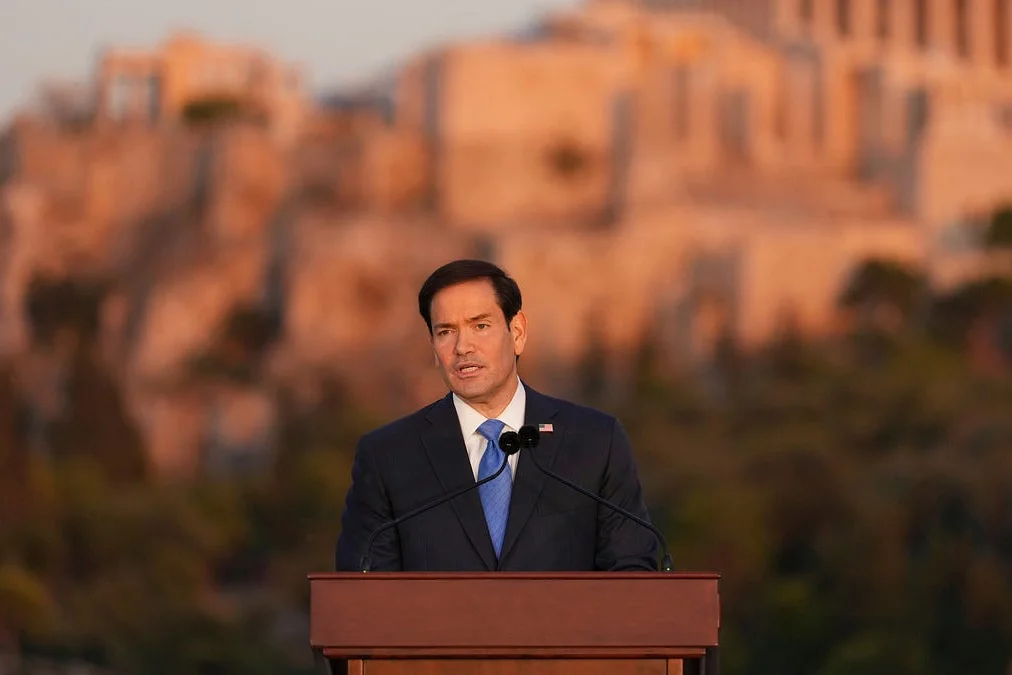
Standing beneath the Acropolis on October 7, 2026, Secretary of State Marco Rubio delivered a sweeping address calling on the West to rediscover its “civilizational roots,” defend national sovereignty, and embrace a renewed sense of confidence in Western values. He argued that nations should place their own interests first and warned against the erosion of sovereignty through global institutions.
On its surface, the speech appeared to be an appeal for Western renewal. Yet viewed in the broader context of the Trump administration's increasingly confrontational posture toward the European Union, it sounded less like a call for partnership and more like an exercise in ideological self-congratulation. If "Make America Great Again" was the slogan of Trump's first political era, a fitting description of this phase might be: "Make America Gloat Again".
makeamericagloatagain.com
The paradox was impossible to miss. Rubio delivered his remarks while traveling through NATO allies and reassuring European partners of America's commitment to their security. At the same time, the administration he represents has repeatedly criticized European governments, questioned the value of longstanding institutions, and portrayed many EU policies as symptoms of decline.
Rubio's speech emphasized nationalism as a virtue and suggested that Western societies weakened themselves by becoming ashamed of their past achievements and by transferring authority to international bodies. Critics may find elements of that argument worth debating. Democracies should examine whether international institutions remain accountable and whether national interests are being effectively defended.
But there is a crucial distinction between confidence and arrogance.
Confidence seeks cooperation from a position of strength. Arrogance seeks validation from a position of superiority.
Too often, the Trump administration's message to Europe has sounded less like a trusted ally offering advice and more like a triumphant critic reveling in perceived European failures. The implication is that America alone has rediscovered the truth while Europe remains trapped by bureaucracy, immigration policies, environmental regulations, or social liberalism. Such rhetoric may energize populist audiences at home, but it weakens the mutual respect that alliances require.
The irony is particularly striking given the setting. The Acropolis stands not merely as a monument to power but as a reminder of democratic experimentation, intellectual exchange, and the interconnected development of Western civilization. The history Rubio celebrated belongs not to one nation but to many. Greece, Rome, Britain, France, Germany, Italy, Poland, Spain, and the United States all contributed to the political and cultural traditions that define the modern West.
No single country owns that inheritance.
Yet the administration's recent approach often suggests otherwise. Europe is treated less as a partner than as a cautionary tale. Every economic slowdown becomes proof of failure. Every policy disagreement becomes evidence of civilizational decline. Every dispute becomes another opportunity for Washington to declare itself the wiser and stronger actor.
That is where the danger of "Make America Gloat Again" emerges.
Great powers that spend their time congratulating themselves frequently lose sight of their own shortcomings. The United States faces immense challenges of its own: political polarization, mounting debt, infrastructure needs, threats to democratic norms, and fierce global competition. These are not problems that disappear simply because European governments can be mocked or lectured.
Moreover, America's influence has always depended on something larger than military or economic power. It has depended on the willingness of allies to follow its leadership because they respected its judgment. Respect cannot be sustained through constant ridicule. Alliances thrive on trust, not humiliation.
Rubio's Athens speech may ultimately be remembered less for its celebration of Western civilization than for the tension it revealed within contemporary American conservatism. It spoke the language of alliance while embracing a political worldview that often treats allies as adversaries. It praised a shared Western heritage while elevating national rivalry within the Western family itself.
The United States does not need to choose between patriotism and partnership. It can champion its interests while respecting those of its democratic allies. Indeed, that balance has been one of the central strengths of American leadership since World War II.
The challenge for Washington is not to make America gloat again. It is to make America lead again. Leadership requires confidence, humility, and the recognition that even the strongest nation benefits from friends who are treated as equals rather than targets of scorn. Without that understanding, celebrations of Western unity risk becoming little more than speeches delivered against beautiful backdrops while the foundations of the alliance slowly erode.