By The EasyWebSight Desk
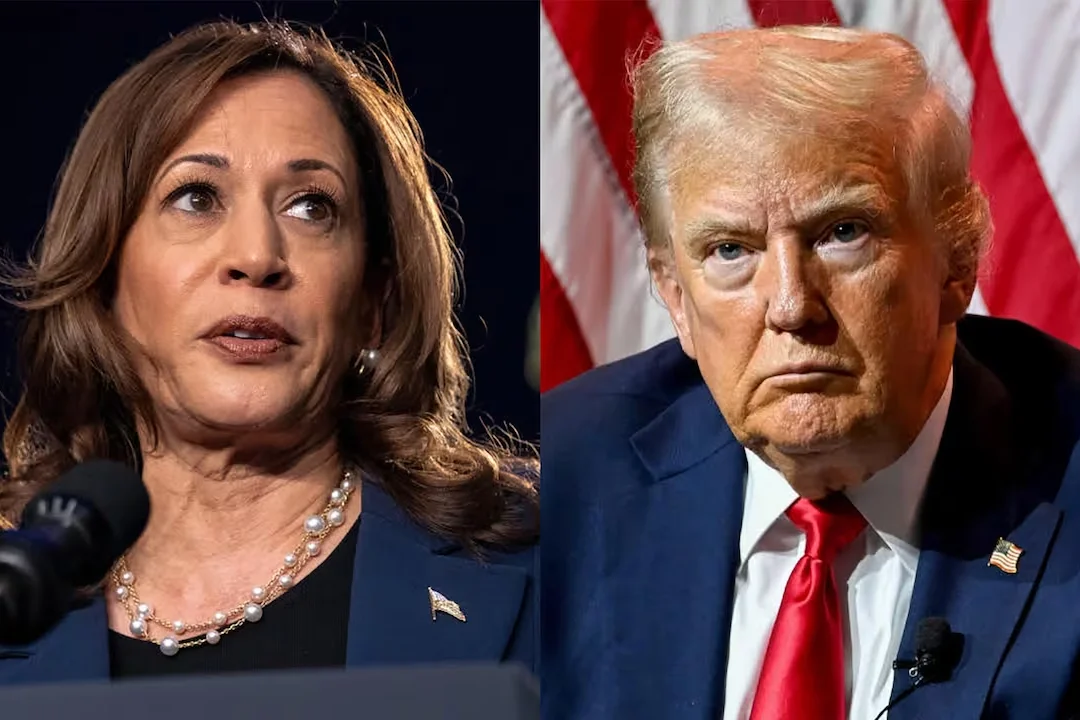
There are moments in American political history when a single sentence reveals more about the nation's unresolved racial tensions than an entire campaign season. One such moment occurred on July 31, 2024, when Donald Trump questioned Kamala Harris's racial identity during an appearance before the National Association of Black Journalists in Chicago.
The controversy was not simply about Harris, her ancestry, or the political loyalties of Black Americans. It raised a more fundamental question: Who gets to decide what race another American belongs to?
Trump's remarks suggested that racial identity was something a person could adopt, abandon, or conveniently exchange depending on political circumstances. But the implication went further. It suggested that someone else—perhaps a political opponent—could determine whether that identity was authentic.
And that is where the absurdity begins.
Because if racial identity can be switched on and off, perhaps millions of Americans missed the announcement. Perhaps there was a particular morning when Kamala Harris woke up, looked in the mirror, and decided that today would be the day she turned Black.
Of course, no such morning ever existed.
Yet the suggestion that it might have is precisely what made Trump's comments so revealing.
A Question That Should Never Have Been Asked
During his appearance at the National Association of Black Journalists convention, Trump declared:
“I didn't know she was Black until a number of years ago when she happened to turn Black.”
He then asked whether Harris was Indian or Black, as though the two identities were mutually exclusive.
The statement was extraordinary, not because Harris's background was mysterious, but because it was so thoroughly documented.
Kamala Harris was born in Oakland, California, in 1964. Her father, Donald Harris, was born in Jamaica, and her mother, Shyamala Gopalan, was born in India. Both immigrated to the United States, where their daughter grew up with an understanding of her multicultural heritage.
Harris attended Howard University, one of America's most prominent historically Black universities. She joined Alpha Kappa Alpha, a historically Black sorority, and later served in the Congressional Black Caucus during her time in the United States Senate.
None of this was secret. None of it represented a sudden transformation.
Yet Trump presented her identity as though it were a political costume she had recently discovered in her closet.
The factual problem with his assertion is straightforward: Harris did not suddenly become Black. She has long identified with both her Black and Indian heritage.
The Fiction of Racial Transformation
Imagine, for a moment, that Trump's interpretation of racial identity were correct.
Imagine an America in which people could simply wake up one morning and change their race.
Would there be an application process? Would the government issue certificates? Would a person's ancestry change overnight? Would decades of family history suddenly become irrelevant?
And who would possess the authority to approve these transformations?
The questions sound ridiculous because the premise is ridiculous.
Yet beneath the humor lies something profoundly serious.
America has a long and troubling history of allowing powerful institutions to define racial identity. For generations, laws determined who could marry whom, where people could live, which schools children could attend, and what opportunities individuals could pursue—all according to racial classifications.
The infamous one-drop rule, embedded in the country's history of racial discrimination, treated even distant African ancestry as sufficient grounds for classifying someone as Black.
Now consider the irony.
For much of American history, people of African descent were denied the freedom to escape racial classifications imposed upon them. Yet in Trump's telling, a woman with a Jamaican father could somehow be accused of manufacturing her Black identity for political advantage.
Yesterday, America insisted that ancestry determined race.
Today, a political figure suggests that ancestry may not count unless he personally recognizes it.
That contradiction deserves examination.
The America of More Than One Identity
The United States has never been as racially simple as some political narratives suggest.
Millions of Americans have parents, grandparents, and ancestors from different racial, ethnic, and national backgrounds.
A person can be Black and Asian. A person can be Hispanic and Black. A person can identify as multiracial without rejecting any part of their ancestry.
These identities are not competing political memberships.
They are reflections of family, history, culture, and personal experience.
Harris's Indian heritage does not cancel her Jamaican ancestry. Her Black identity does not erase her mother's cultural influence.
To insist otherwise is to impose an artificial choice upon people whose lives cannot be reduced to a single category.
It also confuses race with ethnicity, nationality, and cultural identity—concepts that overlap but are not interchangeable.
A Jamaican American may be Black. An Indian American may identify as Asian. Their child may legitimately identify with both backgrounds.
There is no contradiction.
Why Trump's Remarks Mattered
Trump's defenders could argue that he was questioning how Harris presented herself politically rather than literally disputing her ancestry.
Political candidates do emphasize different aspects of their biographies before different audiences. Such choices are legitimate subjects for journalistic scrutiny.
But scrutiny requires evidence.
If a candidate has misrepresented personal history, the appropriate response is to identify the inaccurate statement, establish the facts, and explain why the discrepancy matters.
Trump did not establish that Harris had concealed or fabricated her Black ancestry.
Instead, he suggested that she had undergone a racial transformation.
The distinction matters because political criticism should focus on conduct, decisions, policies, and documented inconsistencies—not unsupported suspicions about someone's racial authenticity.
Americans had ample grounds on which to evaluate Harris's political career: her record as California attorney general, her years in the Senate, her performance as vice president, and her policy proposals.
Those subjects invited serious disagreement.
Whether she had suddenly become Black did not.
The Politics of Belonging
Trump's remarks also fit into a broader American political tradition in which questions about identity become substitutes for debates about qualifications and policy.
During Barack Obama's presidency, false claims about his birthplace became a major political controversy. Trump himself played a prominent role in promoting doubts about Obama's American birth before publicly acknowledging in 2016 that Obama was born in the United States.
The controversies differ in their particulars, but they share a troubling feature: an individual's legitimacy becomes entangled with questions about whether that person truly belongs.
With Obama, the controversy centered on birthplace and citizenship.
With Harris, the challenge centered on racial authenticity.
In both cases, the political conversation moved away from governing and toward identity.
Such arguments can be powerful because they appeal to emotions deeper than ordinary policy disagreements. They invite audiences to question whether a public figure is genuine, trustworthy, or sufficiently connected to a particular community.
But identity is not a substitute for evidence, and suspicion is not proof.
The Day That Never Happened
The title The Day I Turned Black captures the central absurdity of this controversy.
There was no dramatic announcement.
No ceremony.
No sudden change of ancestry.
No moment when Kamala Harris ceased being Indian and began being Black.
There was only a political statement suggesting that such a transformation had occurred.
And perhaps that is the most revealing aspect of the episode.
Trump's words did not change Harris's identity. They exposed how easily racial identity can become a political weapon when public figures treat ancestry as something to be questioned selectively.
Harris responded to the controversy by describing the remarks as another example of divisiveness and disrespect. Her response reflected a larger concern: that Americans deserve political leadership capable of addressing their differences without turning those differences into grounds for suspicion.
People may disagree with Harris's politics. They may criticize her decisions, challenge her proposals, or reject her vision for the country.
That is democracy.
But disagreeing with a politician does not confer the authority to rewrite that politician's family history.
The Real Question
The lasting significance of Trump's remarks is not whether Kamala Harris successfully defended her racial identity.
She had no obligation to prove that her Jamaican ancestry existed, just as she had no obligation to abandon her Indian heritage to satisfy someone else's understanding of race.
The larger issue is why American politics remains so susceptible to arguments about who qualifies as authentically American, authentically Black, or authentically anything else.
In a country shaped by immigration, slavery, cultural exchange, and generations of interracial families, the demand that every person fit neatly into a single racial category is increasingly disconnected from reality.
America's diversity cannot be understood through an either-or question.
The daughter of a Jamaican father and an Indian mother does not need to choose which parent counts.
Her identity is not a contradiction to be resolved.
It is a history to be understood.
And so the question raised by Trump's remarks should never have been when Kamala Harris turned Black.
The question should have been why anyone believed they had the authority to decide when she became Black in the first place.