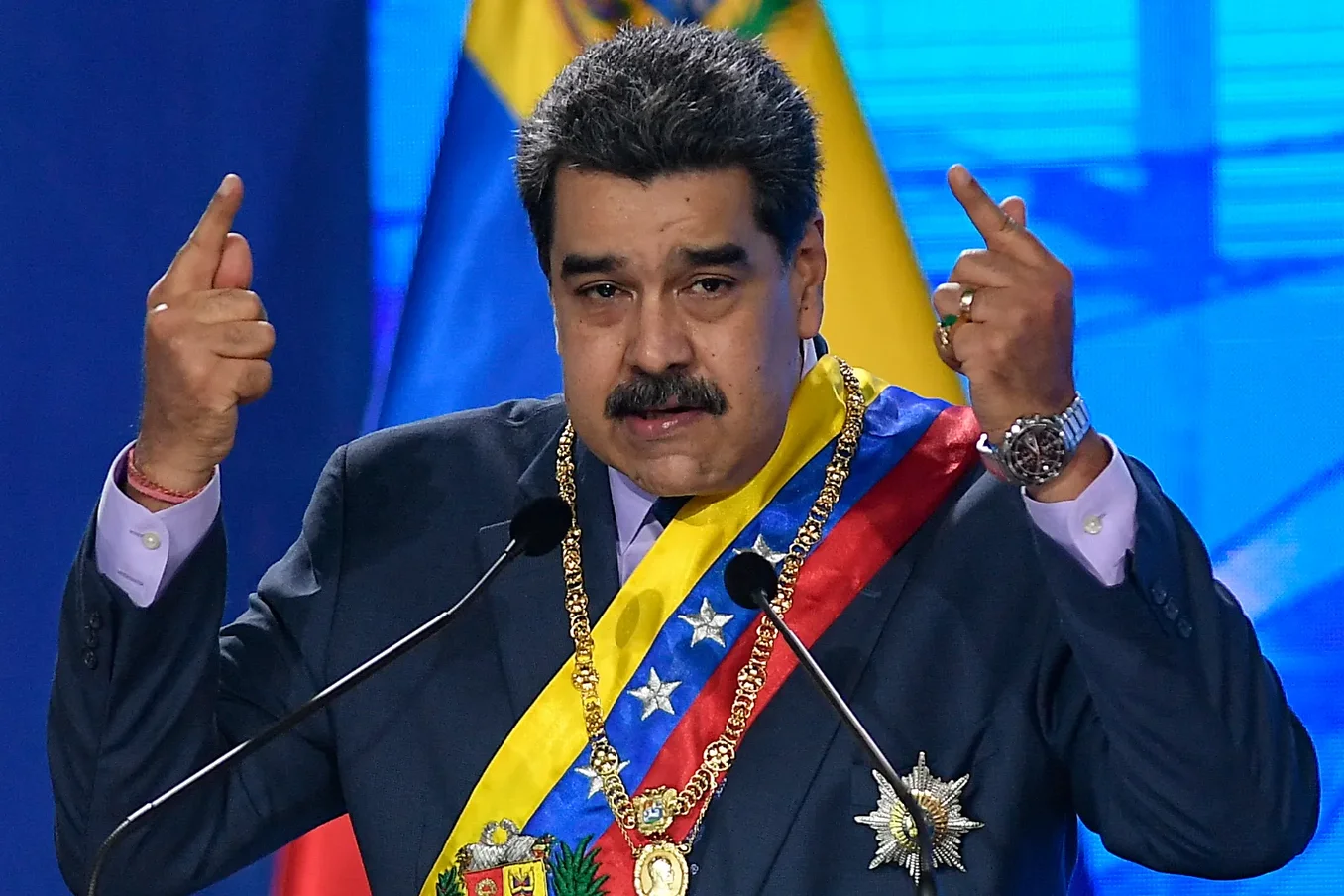
From Maduro’s Kleptocracy to Trump’s Venezuela: Has the System Really Changed?
For more than a decade, Venezuela under Nicolás Maduro became synonymous with authoritarianism, corruption, economic collapse, and the systematic diversion of the nation's enormous oil wealth into the hands of a political and military elite.
Then, in January 2026, everything appeared to change.
The United States removed Maduro from power. Washington established a new relationship with Venezuela's government, opened the country's oil industry to renewed foreign investment, and assumed extraordinary control over Venezuelan oil revenues.
To many Venezuelans and Americans, this represented the destruction of the Maduro system.
But there is a more uncomfortable possibility.
Perhaps Venezuela did not move from kleptocracy to democracy. Perhaps it moved from one system of control over the country's wealth to another.
That is the question behind the provocative description of Venezuela's transformation as a move from a “Maduro kleptocracy” to a “Trump kleptocracy.”
The phrase should not be understood as a literal legal classification of the Trump administration. Rather, it describes a troubling possibility: that the removal of Maduro has changed who controls Venezuela's resources without necessarily changing the underlying political economy that allowed those resources to be appropriated by those in power.
The Maduro Model
Under Hugo Chávez and subsequently Nicolás Maduro, Venezuela's enormous petroleum reserves became the foundation of political power.
The Chávez government nationalized and consolidated control over the petroleum industry through PDVSA, Venezuela's state oil company. Oil revenues financed government programs, subsidized consumption, supported political allies and strengthened the government's ability to maintain political control.
Under Maduro, however, the system deteriorated dramatically.
The collapse in oil production, the decline in global oil prices, international sanctions, economic mismanagement and widespread corruption produced an extraordinary economic catastrophe. Venezuela's institutions became increasingly politicized, while the military and politically connected business interests acquired enormous economic influence.
The result was not simply an authoritarian government.
It was an economic system organized around political access.
Those who controlled the state controlled access to oil, foreign currency, contracts, imports, licenses and other sources of wealth.
In that sense, Venezuela became a classic example of a resource-rich state in which political power and economic power became almost indistinguishable.
The Venezuelan people technically owned the country's natural resources through their government.
But ordinary Venezuelans had remarkably little control over how those resources were managed.
That distinction is crucial.
January 2026 Changed the Equation
The removal of Maduro fundamentally altered the balance of power.
But it did not mean that Venezuela suddenly acquired an independent democratic government.
Instead, Delcy Rodríguez, Maduro's former vice president, became the country's interim leader while maintaining important elements of the existing Chavista political structure.
At the same time, Washington acquired an unprecedented degree of influence over Venezuela's economy.
The Trump administration's January 2026 executive order explicitly established U.S. custody over Venezuelan government oil revenues held in U.S. Treasury accounts. The order itself describes the funds as Venezuelan government property, not American property, and characterizes the United States' role as custodial.
But legally owning the money and controlling its movement are two very different things.
And that distinction has become the center of the controversy.
“We're in Charge”
Perhaps the clearest indication of the new relationship came from Donald Trump himself.
When asked about Venezuela shortly after Maduro's removal, Trump answered bluntly:
“We're in charge.”
That statement is important because it goes beyond ordinary diplomatic influence.
The United States was no longer merely imposing sanctions on Caracas or attempting to influence Venezuelan policy from outside.
Washington had become deeply involved in determining how the country's most important source of wealth would be managed.
And oil is not a minor Venezuelan asset.
It is the foundation of the country's economy.
The Oil Money Problem
This brings us to the most troubling question surrounding the new arrangement:
Who controls Venezuela's oil money?
The answer is complicated.
The Trump administration says the revenues belong to Venezuela and that the United States is holding and administering the funds for the benefit of Venezuelans and Americans.
The January executive order explicitly describes the funds as Venezuelan property held by the United States in a custodial capacity.
But by July, the Financial Times estimated that more than $13 billion in Venezuelan oil revenue had passed through the U.S.-controlled system since January.
The newspaper also reported that the Trump administration had provided inconsistent explanations about how the money was being handled. Trump himself has publicly described the United States as making substantial money from Venezuelan oil, while administration documents have characterized the U.S. role as custodial.
That contradiction is politically significant.
If the money belongs to Venezuela, why does Washington have such extensive authority over it?
If Washington is merely acting as a custodian, why does the American president speak about the United States making money from Venezuelan oil?
And if the oil revenues are genuinely being spent for the benefit of Venezuelans, where is the detailed public accounting?
These are not merely accounting questions.
They are questions about sovereignty.
The Difference Between Ownership and Control
Imagine that someone tells you:
“Your money is still yours. I'm simply keeping it in my account, deciding when you can withdraw it, determining what you can spend it on, and deciding which expenses I consider legitimate.”
Legally, one might still say the money belongs to you.
But economically and politically, the person controlling access to the money possesses enormous power over you.
That is essentially the dilemma facing Venezuela.
The United States may not claim legal ownership of Venezuela's petroleum wealth.
But Washington possesses extraordinary leverage over the revenue generated by that wealth.
The Congressional and policy debate has therefore increasingly focused not only on who owns Venezuela's oil, but on who controls the cash generated by it.
The Council on Foreign Relations has warned that the lack of transparency and a clear democratic roadmap could allow the United States to entrench a corrupt successor system rather than create a democratic one.
The Return of Big Oil
At the same time, the Venezuelan oil industry is being reopened to international companies.
This is not necessarily a bad thing.
In fact, Venezuela desperately needs foreign investment.
Its oil infrastructure has deteriorated after years of underinvestment and mismanagement. Increasing production could generate enormous revenue, create employment and help rebuild the Venezuelan economy.
The problem is not necessarily the presence of foreign companies.
The problem is who sets the rules, who receives the profits, who controls the contracts, and who is accountable to the Venezuelan people.
In 2026, major international energy companies began returning to Venezuela. BP, for example, received authorization for a major offshore gas project involving ADNOC and Qatar-based UCC Oil & Gas. Venezuela's new hydrocarbons framework has also reduced the dominance of PDVSA and encouraged foreign investment.
From an economic perspective, this could be the beginning of Venezuela's recovery.
From a political perspective, however, it raises an uncomfortable question:
Is Venezuela rebuilding its economy—or is its petroleum industry being reorganized primarily around the interests of foreign investors and Washington?
The answer does not have to be one or the other.
It could be both.
The New Political Bargain
The emerging political arrangement appears to rest on a pragmatic bargain.
Washington gets access to Venezuelan oil and enormous influence over the country's economic future.
The Rodríguez government gets international recognition, access to oil revenues and political survival.
Foreign energy companies get access to one of the world's largest petroleum reserves.
And the Venezuelan people are promised economic recovery.
What is missing from this bargain is a fourth participant:
the Venezuelan electorate.
A genuine democratic transition would require Venezuelans themselves to determine who governs them and how their national wealth is administered.
That is why the status of the opposition is so important.
María Corina Machado and other Venezuelan opposition figures have argued for a democratic transition based on competitive elections.
Yet the Trump administration has increasingly worked with the Rodríguez government, prioritizing stability and economic cooperation. Recent reporting has described the opposition as being partially sidelined while Washington works directly with the interim government.
That creates a remarkable historical irony.
The United States spent years condemning Maduro because Venezuela lacked legitimate democratic institutions.
After Maduro's removal, Washington now finds itself cooperating with important elements of the very political establishment that Maduro represented.
From Regime Change to Regime Management
This may be the most important distinction.
The original expectation surrounding Maduro's removal was regime change.
But what appears to be emerging is something closer to regime management.
Washington does not necessarily need to destroy every institution of the Chavista state.
It needs those institutions to cooperate.
The Rodríguez government can remain in place so long as it provides stability, facilitates oil production, permits foreign investment and accepts American oversight.
This is a very different objective from building a liberal democracy.
It is closer to managing a strategically important country whose principal resource happens to be extraordinarily valuable to the United States.
And history provides plenty of examples of great powers adopting precisely this approach toward resource-rich countries.
Is This Really a “Trump Kleptocracy”?
This is where the phrase needs to be used carefully.
There is not sufficient evidence to conclude that the Trump administration itself constitutes a kleptocracy in Venezuela.
That would require demonstrating systematic personal enrichment or the diversion of public resources to Trump and his political associates.
The evidence available today does not establish that.
But the term can nevertheless be useful as a warning about the structure of power.
A kleptocracy exists when public resources become instruments of political power and private enrichment rather than being governed transparently for the public good.
The danger in Venezuela is therefore not necessarily that Washington will literally steal Venezuela's oil.
The more subtle danger is that Venezuela's oil wealth could once again be distributed according to political relationships rather than democratic institutions.
The beneficiaries would simply be different.
Under Maduro, the beneficiaries were primarily Chavista political elites, military interests and connected businessmen.
Under a U.S.-dominated system, the beneficiaries could include American strategic interests, multinational energy companies, politically connected Venezuelan elites and foreign investors.
If ordinary Venezuelans remain without meaningful control over the process, the fundamental problem has not disappeared.
The names have changed.
The institutions have changed.
The ownership arrangements have changed.
But the concentration of economic power may remain.
The Great Test
There is, however, another possible future.
The United States could use its extraordinary leverage over Venezuela to accomplish something genuinely historic.
It could insist upon:
- transparent management of oil revenues;
- independent auditing;
- strong anti-corruption institutions;
- an independent judiciary;
- competitive elections;
- protection of political opposition;
- independent media;
- private property rights;
- transparent oil contracts;
- and a system in which Venezuelans—not American officials—ultimately control their national wealth.
If that happens, history may judge the 2026 intervention very differently.
The United States could have used its temporary control over Venezuela's petroleum economy to dismantle the institutional foundations of kleptocracy and establish the conditions for democratic government.
But that requires Washington to eventually give up control.
And that may be the hardest part.
Power acquired in the name of transition has a tendency to become power retained in the name of stability.
The Central Question
Venezuela therefore stands at a remarkable crossroads.
For decades, its people watched their country's extraordinary oil wealth become concentrated in the hands of political elites.
First it was the old Venezuelan establishment.
Then it was Chávez and the Chavista movement.
Then Maduro, the military and their economic networks.
Now the United States has acquired extraordinary influence over the same resource.
The question is not simply whether Venezuela's oil production increases.
It is not simply whether foreign investment returns.
It is not even simply whether the Venezuelan economy grows.
The fundamental question is:
Who ultimately controls Venezuela's wealth?
If the answer remains “whoever controls the government,” then Venezuela's underlying political economy may not have changed nearly as much as it appears.
Maduro's kleptocracy was built on the principle that political power provided access to the nation's wealth.
A democratic Venezuela would reverse that relationship:
The nation's wealth would belong to its people, and political leaders would merely administer it on their behalf.
That is the standard by which the post-Maduro transition should ultimately be judged.
Not by how many barrels of oil Venezuela produces.
Not by how many American companies return.
Not by how much money Washington collects.
And not even by whether Maduro is gone.
The real test is whether Venezuelans themselves eventually regain control over the institutions and resources of their own country.
If they do, the removal of Maduro may become the beginning of Venezuela's democratic rebirth.
If they do not, history may record something considerably less revolutionary:
one system of political control over Venezuela's oil wealth being replaced by another.