By The EasyWebSight Desk
A New Deal for the Checkout Line
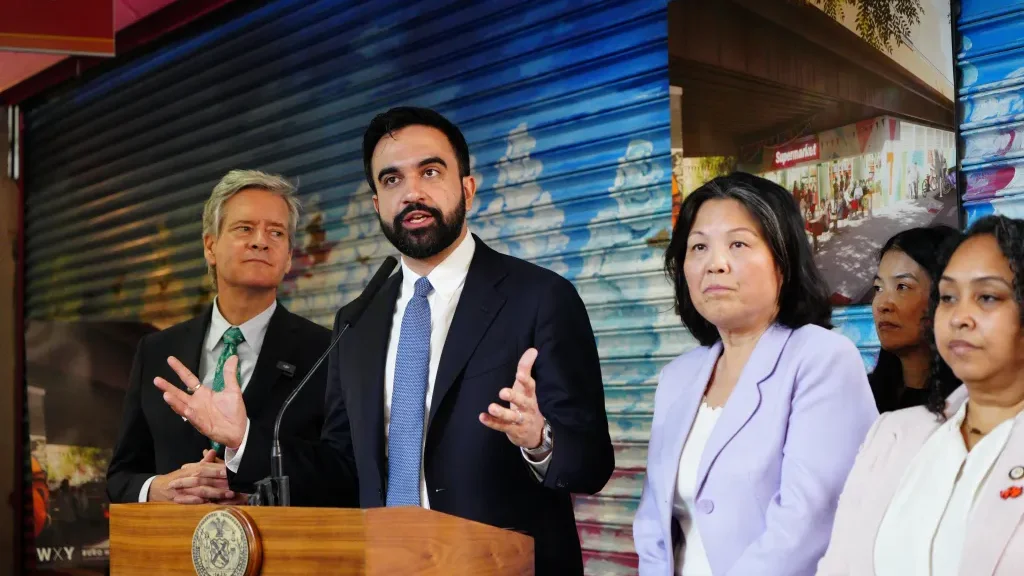
NEW YORK — In a city where the price of eggs has become a political talking point and a gallon of milk can feel like a luxury, Mayor Zohran Mamdani is advancing one of the most unconventional ideas of his young administration: grocery stores owned, subsidized and, in part, governed by the city itself.
The proposal, unveiled in April as part of a broader affordability agenda, calls for the creation of five municipally backed supermarkets — one in each borough — designed to sell staple goods at prices below the private market.
It is, as the mayor has framed it, “a grand experiment” in using public power to tame private costs.
A City Steps Into the Aisles
The plan is straightforward in design, if ambitious in scope. The city would finance and own the stores, subsidizing essential goods — bread, eggs, milk — while contracting private operators to run day-to-day operations under strict pricing and labor standards.
The first location is slated for East Harlem, at the historic La Marqueta site, a neighborhood chosen for its lower median income and high reliance on public assistance.
City officials say the goal is not to replace private grocers but to compete with them — and, in theory, drive prices down across the market.
“At our stores, eggs will be cheaper. Bread will be cheaper,” the mayor said when announcing the initiative, framing grocery shopping as an “unsolvable equation” for too many New Yorkers.
The Economics of Intervention
The numbers are significant. The city has allocated roughly $70 million in capital funding for the five-store pilot, with the East Harlem flagship alone expected to cost about $30 million to build.
Officials argue the investment is justified by a decade of rising food prices, which have outpaced national trends and strained household budgets.
But the economics of the model remain unsettled.
The stores would likely operate with ongoing subsidies, particularly if they are to guarantee lower prices while paying union wages and maintaining stable supply.
Even within City Hall, there is acknowledgment that only a “core basket” of goods may consistently be cheaper than market alternatives.
A Revival of an Old Idea
Publicly owned food markets are not without precedent. In the early 20th century, cities experimented with municipal markets to stabilize prices during periods of economic stress. Mamdani has explicitly invoked that history, drawing parallels to New Deal-era interventions.
But in modern America, the concept has largely faded — replaced by private chains, global supply networks and thin-margin competition.
Bringing it back, particularly in a city as complex as New York, represents both a policy gamble and a political statement.
Support and Skepticism
Advocates, including anti-hunger organizations, say the plan addresses a gap that food pantries and subsidies alone cannot fill: reliable access to affordable, healthy food.
They see municipal grocery stores as infrastructure — no different, in principle, from public transit or housing.
Critics, however, question whether the model can scale without distorting the market or draining public resources. Some warn that subsidized pricing could undercut existing neighborhood grocers, while others point to the high upfront costs and uncertain long-term viability.
There is also a practical concern: whether a handful of city-run stores can meaningfully affect prices in a sprawling, multi-billion-dollar food system.
A Test of Political Imagination
The first store is expected to open as early as 2027 in a temporary or adapted space, with permanent construction projects extending into 2029.
By then, the success — or failure — of the experiment may help define the Mamdani administration.
At its core, the initiative poses a larger question: Can government act not just as regulator or safety net, but as a direct competitor in essential markets?
For New Yorkers navigating rising costs aisle by aisle, the answer may soon come not in theory, but at the checkout counter.